Projects
Region-Based Background Subtraction
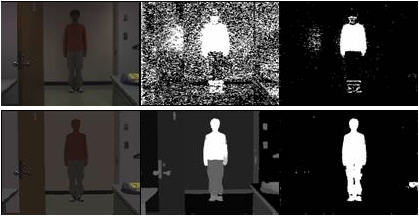
Extracting moving objects from a video clip is the first step in video surveillance. The most popular approach to acquiring moving objects, or foreground objects, is background subtraction. In the process of background subtraction (BGS), a reference background model is subtracted from a given image. Although various background models have been suggested, most are pixel-based and do not use segmentation information. If we have correct segmentation information, we can use it to improve the quality of background subtraction.
Appearance-Based Human Recognition using Color/Path-Length Profile
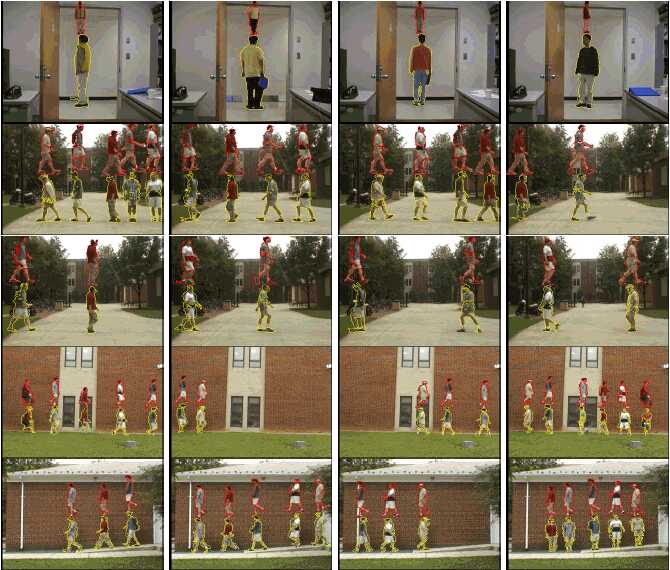
Recognizing a person is a basic task in video understanding. If a person is recognized (or matched) correctly on key-frames, many types of events can be detected. In this project, a new method for recognizing persons based on their overall extrinsic appearance is presented, regardless of their upright pose. The appearance is that of their visible clothing and bodies seen in silhouette obtained by background subtraction. To represent the appearance with suitable spatial information, we introduced a new feature, Color/Path-Length, which is robust under variable conditions such as views, illuminations, sizes, or multiple cameras. Kernel density estimation and Kullback-Leibler distance are used to compare between appearances.
Appearance-Based Local Change Detection
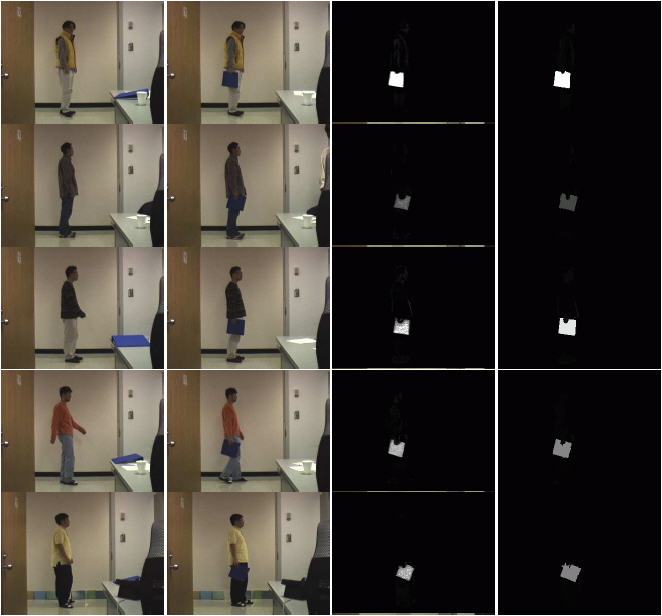
Appearance profile can be used to detect local changes (or local differences) between two frames. When the current frame is decided as an instance of one of known models, we can use the profile further to find if there are any local changes. This idea is especially necessary for the case when either delivery or pickup happens. When someone delivers a package, we should be able to determine two things to understand the event: recognition of person and localization of the difference. To extract the package with clear boundary, it is necessary to examine the probability of all the pixels in the test image. The highlighted region for carried object can be used for higher level inference.
Event Detection in Compressed Video
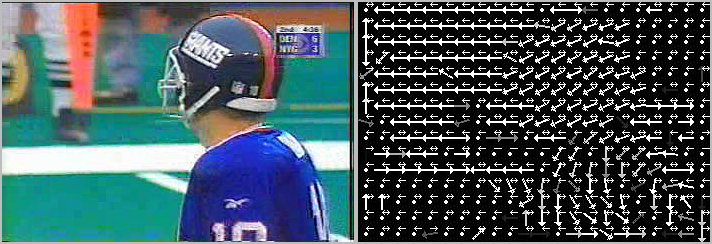
This work focused on the general task of detecting portions of the video that were likely to contain a dynamic event without considering how we might localize or classify it. The event detection module builds feature vectors from 2D histograms of stepwise motion vectors, and finds discontinuities in the trajectories of the feature vectors. A discontinuity indicates that a major reshuffling of the motion vectors occurred, but does not identify the event. It does not indicate whether this was due to a collision or to a fast object suddenly entering the scene. The task of identifying dynamic events (as opposed to just detecting them) requires a series of main tasks: identification of camera motion, segmentation of moving blobs, tracking of moving blobs in the sequence, and analysis/classification of their interactions.